Nearly every large business and enterprise is vulnerable to cyber attack. Malicious actors can gain access to your company’s network and sensitive data through various methods, including email, social media, ransomware, and more. Cyber attacks not only cost hundreds of thousands of dollars, but they can seriously damage your reputation and relationships with customers, vendors, partners, and other stakeholders.
The Rise of Cyber Attacks
Each day, cyber attacks are increasing in both volume and sophistication. According to the 2021 Hiscox Cyber Readiness Report, the percentage of firms that suffered cyber attacks grew from 38% to 43% over the past year. More than 15% of those firms were victims of ransomware and more than half of them paid up. Cybersecurity Ventures predicts that, over the course of 2021, a cyber attack will occur every 11 seconds — more than double the rate in 2019. As a result, your organization needs to have an aggressive cyber security strategy moving forward.
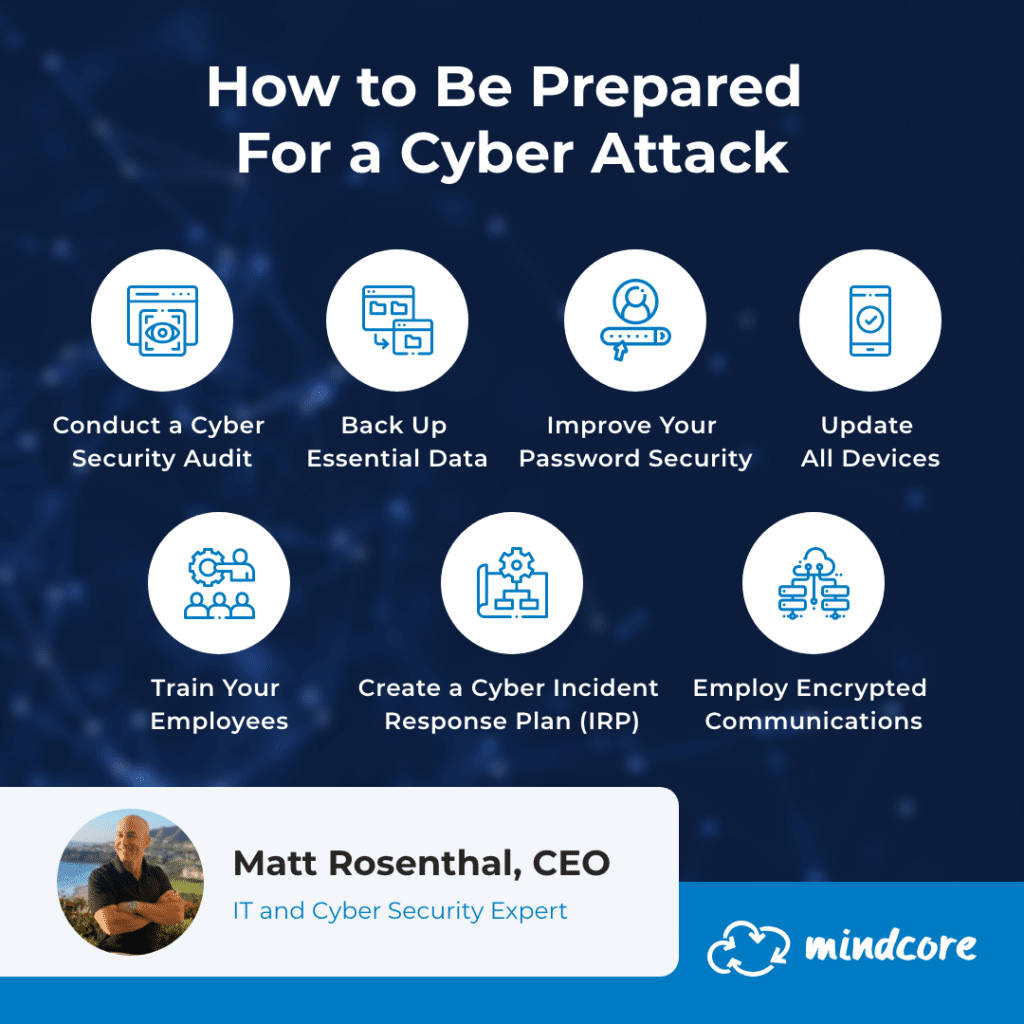
7 Ways to Prepare For a Cyber Attack

How can you protect your organization against cyber attacks? Follow these seven steps to ensure that you and your employees are well prepared if a threat arises.
1. Conduct a Cyber Security Audit
First, you should conduct a thorough cyber security audit to assess what data you have, where it’s stored, how valuable it is, and how vulnerable it is. Consider all the possible means of attack and how well you’re prepared to handle each situation. Once you’ve determined the strengths and weaknesses of your current cyber security infrastructure, you can create a plan and begin troubleshooting the technology.
2. Back Up Essential Data
There is no such thing as 100% protection when it comes to cyber security. Malicious actors will find a way to breach your system, regardless of how many policies and procedures you have in place. Hope for the best, but prepare for the worst by backing up all your critical systems and data, and do it often. Keep one backup onsite and another backup offsite or in the cloud. In case of a ransomware attack, you’ll be able to access your data.
3. Improve Your Password Security
Many companies fail to enforce strict password security on their users. In 2019, a Google/Harris poll revealed that 66% of Americans use the same password for more than one online account. You should require your employees to use unique and complex passwords for each account and device, and encourage them to change their passwords every few months. For an additional layer of security, you should consider utilizing multi-factor authentication.
4. Update All Devices
Many attackers infiltrate protected networks via connected devices that haven’t received the latest security patches. Security patches are issued to address vulnerabilities in a company’s operating system and provide you with bug fixes, new security features, program stability, and more. If you are alerted about a software update on any of your devices, such as printers, computers, or mobile phones, install it as soon as possible.
5. Train Your Employees
Almost all successful cyber attacks share one variable in common: human error. According to security researchers at IBM and the Cyber Security Intelligence Index Report, human error is a major contributing factor in 95% of all breaches. Uninformed or careless employees are often the “weakest link” in cyber security. Train your employees on all cyber security best practices, including how to identify a phishing scam and other social engineering tactics.
6. Create a Cyber Incident Response Plan (IRP)
What will you do if your organization experiences a cyber attack? Do you have a specific plan of action? If not, create an incident response plan (IRP) that outlines, in step-by-step detail, how you will respond to DOS attacks, ransomware attacks, data breaches, and more. Determine who is responsible for collecting, analyzing, and acting upon information gathered from the incident. This way, if and when an attack occurs, you can pull out your IRP and follow the instructions listed.
7. Employ Encrypted Communications
Last but not least, switch to a communications platform that utilizes end-to-end encryption. Communications between employees, especially those working remotely, are vulnerable to interception and attack. This unauthorized access can lead to sensitive information being leaked and provide a backdoor into your organization’s network. If you encrypt all communications from start to finish, malicious actors will be left with distorted nonsense.
Get Prepared For Cyber Attacks with Mindcore
Mindcore provides companies in New Jersey and Florida with high-quality cyber security solutions, including penetration testing, vulnerability scanning, and data backup and recovery. Our team can also help train your employees to maximize your protection against cyber attacks. Contact us today to learn more about our services or schedule a consultation.
Frequently Asked Questions
Why is preparing for a cyberattack important for businesses?
Preparing for a cyberattack helps businesses reduce operational disruption, protect sensitive data, improve recovery speed, and minimize financial and reputational damage during security incidents.
What should a business include in a cyberattack preparedness strategy?
A preparedness strategy should include cybersecurity audits, data backups, strong password policies, patch management, employee security training, encrypted communications, and a documented incident response plan.
Why are backups important during cyberattacks?
Backups help organizations restore systems and recover critical data after ransomware attacks, outages, accidental deletions, or infrastructure failures while maintaining operational continuity.
How does employee training help prevent cyberattacks?
Employee training reduces human error by teaching users how to recognize phishing emails, social engineering tactics, suspicious links, and unsafe security behaviors that attackers commonly exploit.
Why is an incident response plan necessary?
An incident response plan provides structured procedures for detecting, containing, responding to, and recovering from cyber incidents. Clear response steps help organizations react faster and reduce overall impact.
Cyberattack Preparedness and Operational Resilience Expertise from Matt Rosenthal
Matt Rosenthal, CEO of Mindcore Technologies, has extensive experience helping organizations strengthen cyberattack preparedness, operational resilience, and long-term cybersecurity strategy. His expertise in incident response planning, vulnerability management, backup and recovery, employee security awareness, threat monitoring, and infrastructure protection helps businesses reduce exposure to evolving cyber threats. His leadership focuses on building proactive cybersecurity frameworks that improve organizational readiness, strengthen operational continuity, reduce recovery time, and support long-term security maturity across complex business environments.