

The future of cybersecurity will not be defined by bigger firewalls or more alerts. It will be defined by who learns faster. Attackers are already using AI to probe defenses, adapt tactics, and operate continuously. The next generation of attacks will not announce itself. It will predict your response before you act.
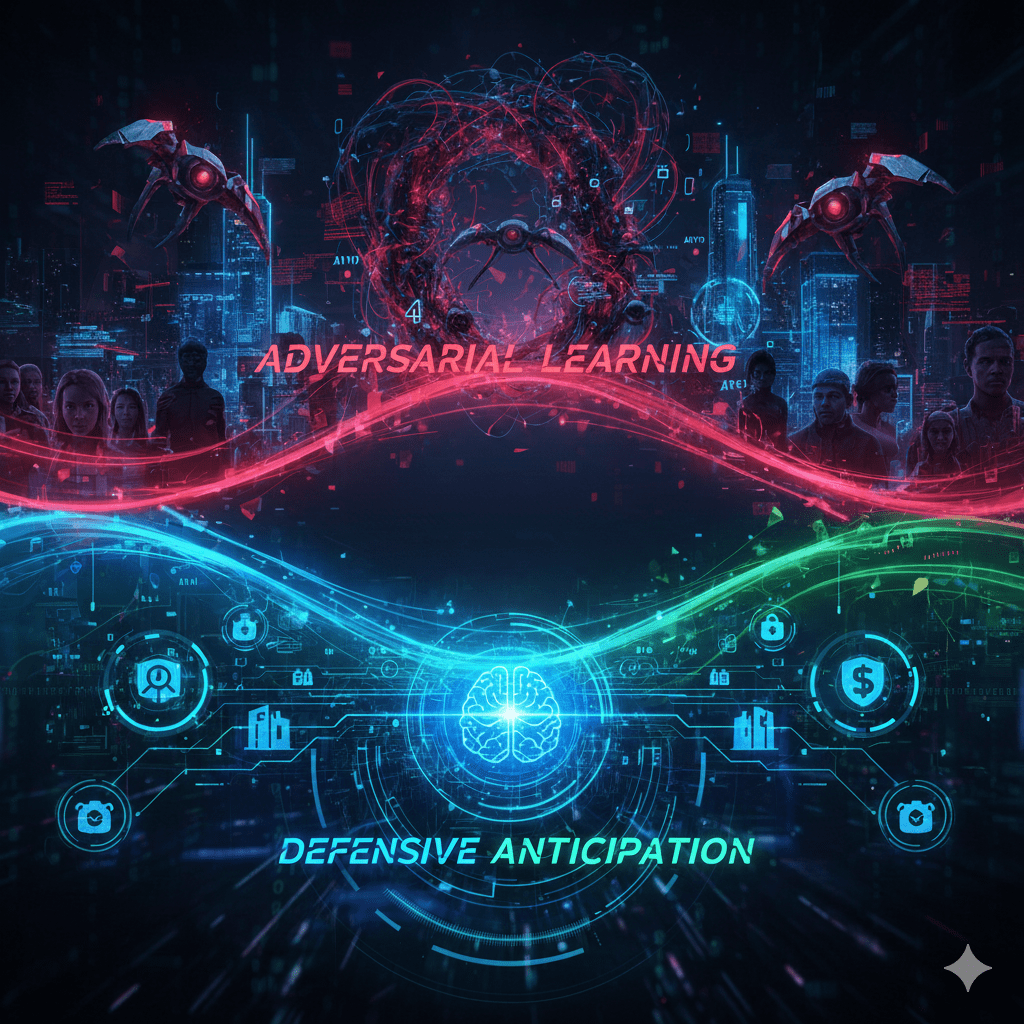
At Mindcore Technologies, we see the future of AI in cybersecurity as a race between adversarial learning and defensive anticipation. Organizations that continue to rely on reactive security will always be behind. Those that use AI to predict and prevent attacks will change the balance.
This article explains where AI-driven attacks are heading, how defensive AI must evolve, and what security leaders should be building now.
Why the Next Generation of Attacks Will Be Harder to See
Future attacks will not look like incidents. They will look like normal operations.
AI enables attackers to:
- Learn baseline behavior before acting
- Operate below detection thresholds
- Abuse identity and trusted workflows
- Adjust tactics based on defensive response
Security tools that wait for known indicators will miss these attacks entirely.
How AI Is Changing the Attacker Playbook
1. Predictive Targeting
Attackers will use AI to identify:
- Which systems matter most
- Which users have leverage
- Which paths offer least resistance
This reduces noise and increases impact.
2. Adaptive Evasion
Future attacks will test defenses incrementally.
AI-driven malware and tooling will:
- Probe controls
- Record failures
- Adjust behavior automatically
Static defenses will be mapped and bypassed over time.
3. Identity-Centric Attacks
Identity will remain the primary attack surface.
AI will:
- Abuse sessions instead of credentials
- Exploit MFA fatigue and trust gaps
- Mimic legitimate user behavior
Authentication alone will not equal security.
4. Data-First Attacks
Encryption is optional. Data theft is not.
AI will prioritize:
- Sensitive data discovery
- Silent exfiltration
- Strategic extortion leverage
Organizations will face pressure even without downtime.
What Defensive AI Must Do Differently
The future of AI in cybersecurity is not more automation. It is better anticipation.
1. Move From Detection to Prediction
Defensive AI must answer:
“What is likely to happen next?”
This requires:
- Long-term behavioral analysis
- Trend identification
- Early risk scoring
Prediction shortens response before damage occurs.
2. Focus on Behavior, Not Indicators
Indicators expire quickly.
Future defenses must:
- Track behavioral drift
- Monitor identity usage patterns
- Correlate weak signals across systems
Behavior reveals intent earlier than alerts.
3. Shrink Dwell Time to Near Zero
The goal is not perfect prevention.
The goal is:
- Immediate detection
- Rapid containment
- Minimal blast radius
AI should compress response cycles to seconds, not hours.
4. Integrate AI Into Every Security Layer
AI must operate across:
- Identity and access
- Endpoints
- Networks
- Cloud platforms
- Data environments
Siloed AI tools create blind spots.
5. Assume Adversarial Learning
Defensive AI must assume attackers are learning.
This means:
- Monitoring for probing behavior
- Rotating detection logic
- Avoiding predictable thresholds
Defenders must adapt as quickly as attackers.
Why Prediction Matters More Than Perfection
Perfect security is impossible.
Predictive security changes outcomes by:
- Identifying risk earlier
- Reducing attacker dwell time
- Limiting decision pressure
- Preserving business continuity
Time advantage wins more battles than accuracy alone.
Where Organizations Will Struggle
The biggest challenges we see ahead include:
- Over-trusting AI output
- Automating without governance
- Ignoring explainability
- Failing to align AI with identity security
- Treating AI as a tool instead of a strategy
AI amplifies discipline. It does not replace it.
What the Next Five Years Will Demand From Security Leaders
Security leaders must:
- Redesign architecture for resilience
- Invest in behavior-driven visibility
- Reduce implicit trust everywhere
- Prepare for continuous engagement
- Balance automation with accountability
The future belongs to organizations that can learn defensively.
How Mindcore Technologies Prepares Organizations for What’s Next
Mindcore helps organizations prepare for the next generation of AI-driven attacks through:
- Predictive threat modeling
- Identity-centric security architecture
- AI-assisted behavioral analytics
- Automated containment with human oversight
- Data protection and exfiltration monitoring
- Continuous security posture evolution
We focus on staying ahead, not reacting after impact.
A Simple Future-Readiness Check
You are not ready for next-generation attacks if:
- Security relies on static rules
- Identity trust persists after login
- Detection is reactive
- Response is manual
- AI systems are not governed
Attackers already operate at machine speed.
Final Takeaway
The future of AI in cybersecurity will be defined by prediction, not reaction. Attackers will continue to use AI to learn, adapt, and exploit trust. Defenders must respond with AI that anticipates behavior, compresses response time, and limits damage before impact occurs.
Organizations that embrace AI as a strategic defensive capability will stay resilient. Those that treat it as another tool will remain vulnerable to threats they never saw coming.
Frequently Asked Questions
How is AI changing the future of cybersecurity?
AI is transforming cybersecurity by improving threat detection, automating incident response, analyzing massive volumes of security data, and helping organizations identify threats faster than traditional manual methods. This supports stronger cybersecurity resilience and operational visibility.
What are next-generation cyberattacks?
Next-generation cyberattacks use advanced techniques such as AI-powered phishing, automated malware, adaptive ransomware, credential abuse, and sophisticated social engineering to bypass traditional security defenses. These attacks evolve rapidly and often operate below traditional detection thresholds.
How does AI help prevent cyberattacks?
AI helps prevent attacks through behavioral analytics, anomaly detection, predictive threat intelligence, automated monitoring, and rapid identification of suspicious activity across networks, endpoints, and cloud environments. These capabilities improve proactive zero-trust security strategies.
What risks come with AI-driven cybersecurity systems?
Potential risks include false positives, overreliance on automation, adversarial AI attacks, integration complexity, governance concerns, and the need for human oversight in high-impact security decisions. Effective governance helps reduce operational and security risks.
Why is proactive cybersecurity important in the age of AI?
Cyber threats evolve rapidly, and reactive security models are often too slow. Proactive cybersecurity helps organizations detect indicators earlier, reduce attack surface, strengthen resilience, and respond before threats escalate through more intelligent incident response strategies.
AI-Driven Cybersecurity and Threat Intelligence Expertise from Matt Rosenthal
Matt Rosenthal, CEO of Mindcore Technologies, has extensive experience helping organizations strengthen cybersecurity resilience, operational continuity, and proactive threat defense through AI-driven security strategies and modern infrastructure architecture. His expertise in AI-powered threat monitoring, zero-trust security, identity governance, behavioral analytics, incident response, and operational risk management helps businesses improve visibility into emerging cyber threats while reducing enterprise exposure. Matt’s leadership focuses on building intelligent cybersecurity frameworks that strengthen detection capabilities, improve operational resilience, reduce attack surface, and support long-term protection against evolving next-generation cyber threats through advanced managed cybersecurity services.
