

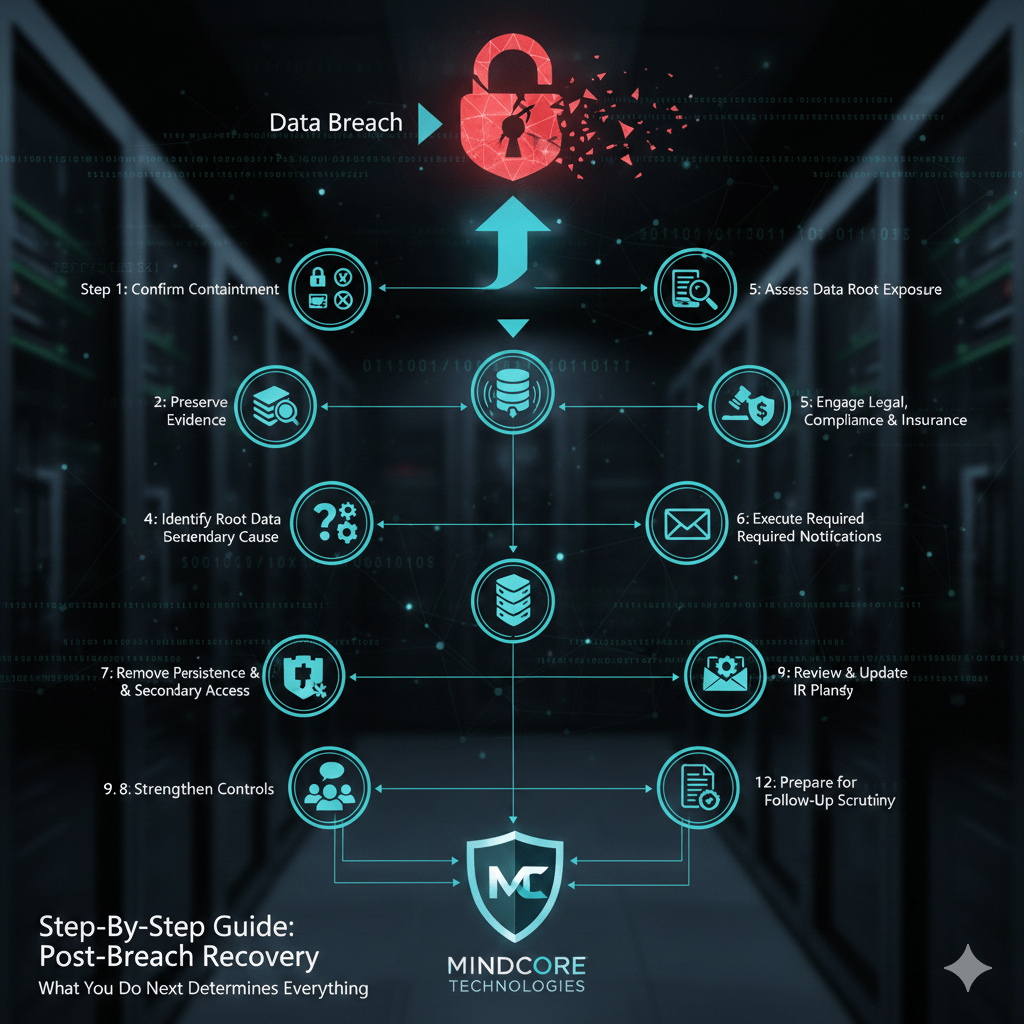
A data breach does not end when access is blocked. That moment only stops the bleeding. What happens next determines whether the incident becomes a short disruption or a long-term business failure.
At Mindcore Technologies, we see the same pattern repeatedly. Organizations that follow a structured post-breach process recover faster, face less regulatory exposure, and dramatically reduce the chance of a second incident. Those that rush or improvise usually repeat the breach.
This is the step-by-step process that actually works after containment.
Step 1: Confirm Containment Is Real
Before doing anything else, verify the attacker no longer has access.
Validate immediately:
- All compromised accounts are disabled or reset
- All active sessions, tokens, and API keys are revoked
- No new suspicious logins appear
- Affected devices are isolated if needed
If access still exists, everything else is premature.
Step 2: Preserve Evidence and Logs
Evidence determines legal exposure, insurance coverage, and remediation accuracy.
Preserve without altering:
- Authentication and access logs
- Cloud and SaaS audit logs
- Firewall, VPN, and gateway logs
- Endpoint activity records
Do not wipe, reimage, or restore yet. Destruction of evidence creates risk.
Step 3: Identify the Root Cause
This is not about blame. It is about control failure.
Answer with evidence:
- How did initial access occur?
- Why was that access possible?
- Which control failed or was missing?
- How long did access exist before detection?
If you cannot explain the “why,” remediation will be superficial.
Step 4: Assess Data Exposure Accurately
Do not guess. Do not minimize.
Determine:
- What data could have been accessed
- Whether data was viewed, modified, or exported
- Which systems and users were involved
- Whether regulated data is in scope (PII, PHI, PCI)
If you cannot prove data was not accessed, assume potential exposure.
Step 5: Engage Legal, Compliance, and Insurance
A data breach is a business and legal event.
Coordinate early with:
- Legal counsel for disclosure guidance
- Compliance teams for regulatory interpretation
- Cyber insurance providers per policy requirements
Notification timing and wording matter. Incorrect handling increases liability.
Step 6: Execute Required Notifications
Once facts are validated and legal guidance is clear:
You may need to notify:
- Regulators
- Affected individuals
- Customers or partners
- Payment processors or platforms
All notifications should be accurate, consistent, and documented.
Step 7: Remove Persistence and Secondary Access
Attackers rarely leave cleanly.
Check for:
- New admin or service accounts
- Inbox rules and email forwarding
- OAuth apps or API integrations
- Scheduled tasks or startup scripts
- Configuration changes
Failure to remove persistence leads to re-compromise.
Step 8: Restore Systems Safely
Restoration must follow remediation, not precede it.
Before restoring:
- Patch exploited vulnerabilities
- Reduce excessive permissions
- Update security configurations
- Validate backup integrity
During restoration:
- Monitor closely
- Restore in phases
- Watch for repeated indicators
Speed without security creates repeat incidents.
Step 9: Strengthen the Controls That Failed
Most breaches succeed because trust is too broad.
Typical post-breach improvements include:
- Enforcing phishing-resistant MFA
- Reducing session lifetimes
- Implementing least-privilege access
- Segmenting networks and data
- Tightening cloud sharing rules
- Improving logging and alerting
Fix the architecture, not just the symptom.
Step 10: Review and Update Incident Response Plans
Treat the breach as a real-world test.
Review honestly:
- Detection speed
- Escalation clarity
- Role ownership
- Communication effectiveness
Update playbooks, contacts, and procedures based on what actually happened.
Step 11: Communicate Internally With Clarity
Employees need guidance, not speculation.
Internal communication should:
- Explain what happened at a high level
- Clarify changes and expectations
- Reinforce security behaviors
- Avoid blame or technical overload
Confusion increases future risk.
Step 12: Prepare for Follow-Up Scrutiny
Expect:
- Regulatory follow-ups
- Insurance audits
- Customer due diligence
- Executive and board review
Documentation and timelines will be examined closely.
Common Post-Breach Mistakes to Avoid
- Declaring the breach “over” too early
- Restoring systems before fixing root cause
- Ignoring cloud and identity logs
- Treating the breach as an IT-only issue
- Failing to redesign access controls
Breaches repeat when lessons are skipped.
How Mindcore Technologies Supports Post-Breach Recovery
Mindcore helps organizations move from incident to resilience through:
- Post-breach validation and investigation
- Identity and access redesign
- Endpoint and network hardening
- Cloud and data access governance
- Long-term detection and monitoring improvements
Our focus is preventing recurrence, not just restoring operations.
Final Takeaway
What you do after a data breach matters more than how it started. A disciplined, step-by-step response reduces damage, protects legal position, and prevents repeat incidents. Organizations that rush back to normal often invite the same breach again.
Frequently Asked Questions
What should organizations do immediately after a data breach?
Organizations should contain the breach, isolate affected systems, activate their incident response plan, assess the scope of exposure, preserve forensic evidence, and begin internal investigation procedures immediately.
Why is rapid incident response important after a data breach?
Rapid response helps reduce operational disruption, limit data exposure, contain attacker movement, minimize financial damage, and improve recovery timelines following a cybersecurity incident. Organizations implementing proactive cybersecurity strategies can detect and contain incidents faster before they escalate.
How should businesses communicate after a data breach?
Businesses should follow legal and regulatory notification requirements, communicate transparently with affected stakeholders, coordinate with legal and cybersecurity teams, and provide guidance for impacted customers or employees. Clear communication helps reduce confusion and maintain trust during recovery efforts.
What are common causes of data breaches?
Common causes include phishing attacks, ransomware, weak passwords, unpatched vulnerabilities, insider threats, insecure remote access, cloud misconfigurations, and compromised credentials. Organizations implementing Zero Trust security frameworks can reduce implicit trust and limit attacker movement across systems.
How can organizations reduce the risk of future data breaches?
Organizations can strengthen resilience through zero-trust architecture, identity governance, continuous monitoring, employee security training, endpoint protection, backup strategies, and proactive incident response planning. Businesses using secure workspace and containment solutions improve visibility and reduce long-term breach exposure.
Incident Response and Data Breach Recovery Expertise from Matt Rosenthal
Matt Rosenthal, CEO of Mindcore Technologies, has extensive experience helping organizations strengthen cybersecurity resilience, incident response readiness, and operational continuity across evolving digital environments. His expertise in zero-trust security, threat monitoring, identity governance, ransomware defense, operational risk management, and breach containment strategies helps businesses reduce exposure to cyber threats while improving response and recovery capabilities. Matt’s leadership focuses on building proactive cybersecurity frameworks that improve operational visibility, strengthen infrastructure resilience, reduce enterprise risk, and support long-term protection against evolving cyber threats.
