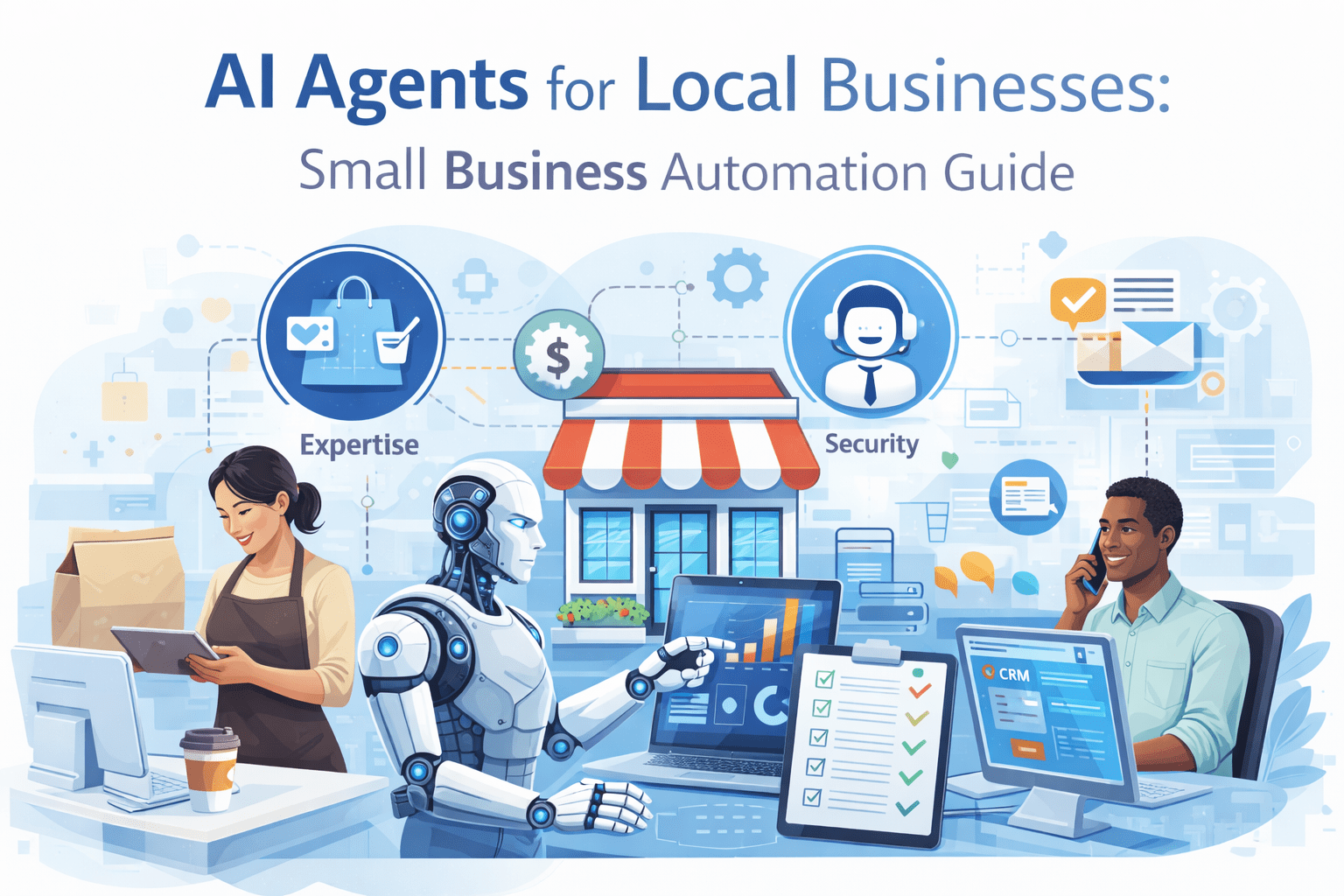
Local business owners wear too many hats. Sales, marketing, customer service, billing, scheduling, inventory, payroll, vendor management. Most of these tasks are repetitive. Most do not generate revenue directly. Yet they consume the majority of time.
This is where AI agents for local businesses create leverage.
AI agents are not complex enterprise systems. They are practical automation tools that reduce manual workload, improve customer response time, streamline back-office tasks, and provide basic operational visibility. When deployed correctly, they act as digital assistants that scale with your business without increasing payroll.
Small business automation does not require large IT teams. It requires structured selection, smart integration, and disciplined rollout.
What AI Agents Actually Do for Local Businesses
AI agents automate routine workflows.
Common small business applications include:
• Automated customer response handling
Instantly reply to inquiries and reduce missed opportunities.
• Appointment scheduling automation
Eliminate manual calendar management.
• Invoice reminders and payment follow-ups
Improve cash flow reliability.
• Basic CRM updates
Automatically log customer interactions.
• Inventory threshold alerts
Prevent stock shortages.
• Social media scheduling support
Maintain consistent marketing presence.
Selection principles are detailed in How Local Businesses Choose Affordable AI Agent Solutions.
Why Small Businesses Need Automation Now
Manual processes create hidden costs.
Without automation:
• Response times slow down
• Customer experience becomes inconsistent
• Administrative workload increases
• Revenue leakage occurs
• Burnout risk rises
The strategic rollout of automation is explained in Local Business AI Strategy: Starting Small and Scaling Up.
Professional vs. DIY AI Approaches
Small businesses often choose between self-managed AI tools and guided professional setups.
DIY benefits:
• Lower upfront cost
• Faster experimentation
DIY risks:
• Integration confusion
• Lack of monitoring
• Scalability limits
Professional guidance comparison is covered in AI Automation for Small Business: Professional vs. DIY Approaches.
Common Implementation Challenges
Local businesses frequently encounter:
• Tool overload
• Poor system integration
• Data inconsistency
• Hidden subscription costs
• Lack of measurable ROI
These issues are explored in Local Business AI Integration: Overcoming Common Implementation Challenges.
Measuring Small Business AI ROI
AI adoption must be measurable.
Track:
• Administrative hours saved
• Increase in lead response speed
• Faster invoice collection cycles
• Reduced scheduling errors
• Improved customer satisfaction
ROI tracking discipline is detailed in Small Business AI ROI: Measuring Success with Limited Budgets.
Choosing the Right AI Provider
Not all AI tools are created equal.
Evaluation criteria are covered in:
• AI Agent Providers for Small Business: Comparing Cost-Effective Options
• Affordable AI Agents: Cost-Effective Solutions for Small Business Operations
Implementation Sequencing Matters
Small businesses should not automate everything at once.
Deployment planning is outlined in AI Agent Implementation for Local Businesses: Step-by-Step Guide.
Key Takeaways
AI agents for local businesses reduce manual workload, improve response speed, streamline scheduling and invoicing processes, and create scalable operational efficiency without requiring large IT investments. Success depends on selecting affordable solutions aligned with real workflow pain points, integrating tools carefully, measuring ROI consistently, and scaling automation gradually. When implemented strategically, AI becomes a practical growth accelerator rather than a complex technical burden.
Frequently Asked Questions
How do AI agents help local businesses?
AI agents help local businesses automate repetitive tasks such as scheduling, customer responses, invoicing, CRM updates, and inventory monitoring. This improves efficiency, reduces manual workload, and allows business owners to focus more on growth and customer relationships.
Are AI agents affordable for small businesses?
Yes, many AI agent solutions are designed specifically for small business budgets and operational needs. Businesses can start with affordable AI agent solutions and scale gradually as workflows and requirements evolve.
What are the biggest benefits of AI automation for local businesses?
AI automation improves response times, reduces administrative overhead, minimizes scheduling errors, and creates more consistent customer experiences. It also helps reduce burnout by automating repetitive operational tasks.
What challenges do local businesses face when implementing AI agents?
Common challenges include poor software integration, tool overload, hidden subscription costs, and lack of measurable ROI. Businesses should implement AI gradually and focus on solving specific workflow problems first.
Should local businesses choose DIY AI tools or professional implementation?
DIY AI tools can be cost-effective for simple workflows, but professional AI implementation often provides better integration, scalability, monitoring, and long-term efficiency. The right choice depends on the complexity of the business operations and growth goals.
Small Business AI Automation Expertise from Matt Rosenthal
Matt Rosenthal, CEO of Mindcore Technologies, has extensive experience helping local businesses improve operational efficiency through secure and scalable technology strategies. His expertise in automation, managed IT services, AI integration, and workflow optimization helps small businesses reduce administrative burdens, improve customer responsiveness, and streamline day-to-day operations using practical AI solutions. His leadership focuses on helping organizations adopt AI strategically so automation improves performance, supports scalability, and delivers measurable operational value without unnecessary complexity.